
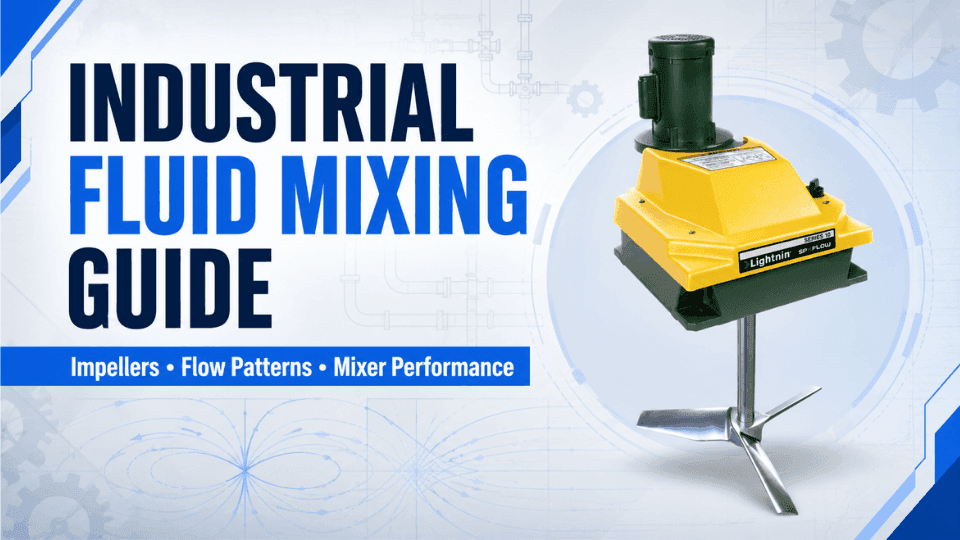
Is your mixing process experiencing settling solids, inconsistent batches, excessive energy use, or longer-than-expected mixing times?
The problem may not be a lack of horsepower. Industrial mixer performance depends on the relationship between the process objective, fluid properties, vessel geometry, impeller design, operating speed, and flow pattern.
Choosing the right industrial mixer can improve circulation, product consistency, heat and mass transfer, solids suspension, and overall process efficiency. Choosing the wrong configuration can create dead zones, uneven processing, unnecessary power consumption, and premature equipment wear.
In this guide, we explain the fundamentals of industrial fluid mixing, including common mixing objectives, axial and radial flow, viscosity and Reynolds number, impeller selection, and the information needed to properly size a Lightnin industrial mixer.
What Is Industrial Fluid Mixing?
Industrial fluid mixing is the controlled movement of liquids or slurries inside a vessel to achieve a desired process result. Although every application is different, successful mixing generally focuses on one or more of these objectives:
- Blending liquids
- Suspending solids
- Dissolving powders
- Heat transfer
- Gas dispersion
- Chemical reactions
- Maintaining uniform consistency
- Preventing settling
Contrary to popular belief, bigger motors do not always produce better mixing. Proper impeller design, tank geometry, shaft length, operating speed, and flow pattern often have a much greater influence on overall performance than horsepower alone.
Selecting the correct mixer begins with understanding what you're trying to accomplish. The following mixing fundamentals will help you evaluate the right solution for your application.
Click the image to watch Mixer Products video.

Why Proper Industrial Mixing Matters
Poor mixing can lead to several costly process problems, including:
- Dead zones inside the tank
- Product inconsistencies
- Settling of solids
- Increased batch times
- Higher operating costs
- Poor chemical reactions
- Reduced production efficiency
- Excessive energy consumption
An optimized mixing system improves product quality while reducing maintenance and operating costs. Proper impeller selection can also help limit unnecessary equipment stress by producing the required flow without relying on excessive power.
This is one reason Lightnin mixers have become a trusted solution across many industries worldwide.
Common Industrial Mixing Objectives
Different industrial processes require different mixing goals. Identifying the objective is one of the most important steps when selecting a mixer.
Blending Liquids
Blending combines two or more compatible liquids into a uniform mixture. Applications include chemical processing, water treatment, food production, and pharmaceutical manufacturing.
The primary objective is achieving consistent concentration throughout the tank in the shortest practical mixing time.
Solids Suspension
Many industrial processes require keeping particles suspended rather than allowing them to settle on the bottom of the vessel.
Examples include:
- Lime slurry
- Mineral processing
- Wastewater treatment
- Pigments
- Chemical slurries
The appropriate impeller and operating conditions create enough circulation to achieve the required degree of solids suspension. Depending on the process, the goal may be to prevent accumulation on the vessel floor, maintain off-bottom suspension, or achieve a more uniform distribution of solids throughout the liquid.
See how impeller selection affects solids suspension inside a mixing vessel. This Lightnin demonstration compares radial-flow and hydrofoil impeller performance.
Gas Dispersion
Gas dispersion introduces gases into liquids for chemical reactions or biological treatment.
Common applications include:
- Aeration
- Fermentation
- Wastewater treatment
- Chemical oxidation
Proper impeller selection improves gas transfer while reducing wasted energy.
Heat Transfer
Many industrial processes rely on effective circulation to evenly distribute heat throughout a vessel.
Good mixing minimizes temperature differences and improves heating or cooling efficiency.
Axial vs. Radial Flow Impellers
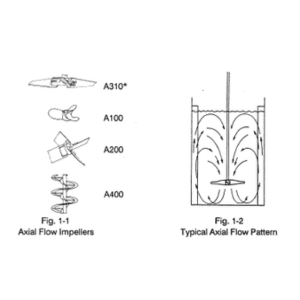
Industrial mixing impellers are generally classified into two broad categories: axial flow and radial flow. Some specialized designs may produce a combination of flow characteristics depending on their geometry and application.
Axial Flow
Axial flow impellers move liquid parallel to the mixer shaft.
These impellers are commonly used for:
- Blending
- Solids suspension
- Heat transfer
- General-purpose mixing
Axial flow designs provide excellent tank circulation while consuming relatively low power.
Radial Flow
Radial flow impellers move liquid out
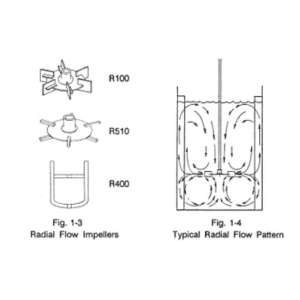
ward toward the tank walls.
These are often selected for:
- Gas dispersion
- High shearapplications
- Certain chemical reactions
Laminar, Transitional, and Turbulent Mixing
Fluid behavior inside a mixing vessel depends on the relationship between fluid density, viscosity, impeller diameter, and operating speed. Engineers commonly use the mixing Reynolds number to determine whether a process operates in the laminar, transitional, or turbulent flow regime.
Laminar Flow
Highly viscous fluids move in smooth layers with very little turbulence.
Examples include:
- Syrups
- Polymers
- Heavy oils
Transitional Flow
This range combines characteristics of both laminar and turbulent mixing.
Turbulent Flow
In the turbulent regime, fluid moves with increased random motion and circulation, which can promote rapid blending and dispersion throughout the vessel.
Understanding Reynolds Number helps engineers determine which flow regime exists and select the proper impeller accordingly.
Choosing the Right Impeller
The impeller is the heart of every industrial mixer.
Different impeller styles are engineered for different objectives.
Factors influencing impeller selection include:
- Liquid viscosity
- Tank dimensions
- Batch size
- Desired mixing time
- Solids concentration
- Gas dispersion requirements
- Shear sensitivity
- Power consumption
Proper impeller selection often delivers greater performance improvements than increasing motor size.
Lightnin offers a wide range of impeller designs developed through decades of research and real-world testing.
Selecting the Right Industrial Mixer
No single mixer fits every application.
Selecting the proper mixer requires evaluating:
- Tank size
- Liquid properties
- Process goals
- Operating temperature
- Pressure
- Chemical compatibility
- Shaft length
- Mounting configuration
- Required horsepower
- Future production needs
Working with an experienced mixing specialist helps ensure optimal performance while avoiding oversized or undersized equipment.
How Tank Design Affects Mixer Performance
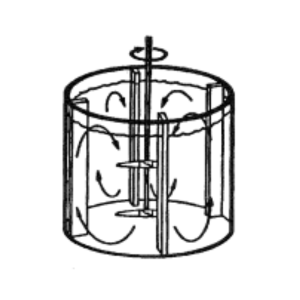
Mixer performance depends on more than the mixer itself. Tank diameter, liquid depth, bottom shape, impeller location, baffles, internal coils, feed locations, and discharge points can all influence circulation.
In many low-viscosity applications, correctly designed baffles help limit excessive swirling and convert rotational motion into more effective top-to-bottom circulation. However, baffle requirements vary with the fluid, impeller, vessel, and process objective. High-viscosity and specialized applications may require a different vessel configuration.
Why Choose Lightnin Industrial Mixers?
For more than a century, Lightnin has been recognized as a global leader in industrial mixing technology.
It’s extensive product line includes solutions for virtually every mixing application, from portable mixers to heavy-duty top-entering systems designed for demanding industrial environments.
Lightnin also offers sanitary mixers for pharmaceutical, biotechnology, food, beverage, personal care, and other hygienic processing applications.
Lightnin mixers are engineered to provide:
- High hydraulic efficiency
- Proven impeller technology
- Reliable long-term operation
- Application-specific configurations
- Reduced maintenance requirements
- Energy-efficient performance
Backed by decades of research, laboratory testing, and computational fluid dynamics (CFD), Lightnin continues to develop innovative mixing technologies that improve process performance across industries.
See how the Lightnin Compact Series Mixer combines a simplified, space-saving design with the durability needed for demanding industrial mixing applications.
Click the image to watch the Compact Series Mixer video.

Centennial Equipment: Your Lightnin Mixing Partner
Choosing the right industrial mixer involves much more than selecting horsepower or speed. Every application has unique process requirements that influence mixer performance.
Centennial Equipment works closely with customers to understand their application and recommend the appropriate Lightnin solution. Our team provides support for new equipment selection, replacement mixers, technical guidance, and ongoing product support.
Whether you’re designing a new process or upgrading an existing system, we can help identify the right mixer configuration for your operation.
Common Industries Using Lightnin Mixers
Lightnin mixers are used in a wide variety of industries, including:
- Water and wastewater treatment
- Chemical processing
- Mining
- Pulp and paper
- Food and beverage
- Pharmaceutical manufacturing
- Power generation
- Industrial manufacturing
- Oil and gas
- General process industries
Each application requires a unique combination of impeller design, shaft configuration, and operating speed to achieve optimal mixing performance.
Frequently Asked Questions
What is the difference between mixing and agitation?
Mixing refers to creating a uniform process condition, while agitation generally describes moving fluid within a vessel. In industrial applications, the terms are often used interchangeably.
How do I choose the right industrial mixer?
Consider the process objective, fluid properties, tank dimensions, solids concentration, operating conditions, and desired mixing time. Working with a knowledgeable supplier helps ensure the correct selection.
Why is impeller design important?
Impeller geometry determines how fluid moves throughout the tank. Proper impeller selection often has a greater impact on performance than increasing motor horsepower.
Which industries use industrial mixers?
Industrial mixers are used in chemical processing, mining, water treatment, food production, pharmaceuticals, pulp and paper, power generation, and many other manufacturing applications.
Improve Mixing Performance with Centennial Equipment
Not sure which mixer, impeller, or mounting configuration fits your process?
Centennial Equipment can evaluate your mixing objective, fluid properties, tank geometry, operating conditions, and existing equipment to help identify an appropriate Lightnin mixer configuration. Contact our team for assistance with new mixer selection, replacement equipment, upgrades, OEM parts, or application support.